Thursday, May 9, 2013
One early introduction to sewing was in a book I read over and over around the 3rd grade: The Five Little Peppers and How They Grew by Margaret Sidney. Published in 1881, a family with a mom and five kids are barely but rather happily surviving in a rundown little house on the money the mother earns by sewing coats. Given the clothing situation these days, and the growing interest in the almost-lost art of sewing, the book I liked as a kid kept coming to mind.
So I tried looking it up tonight. In doing so, I discovered Project Gutenberg . Founded by college student Michael S. Hart in 1971, Project Gutenberg is the oldest digital library, staffed only by volunteers, storing thousands of books and documents that are in the public domain in a number of digital languages. Visit Gutenberg.org
Although working with the Gutenberg website was a little awkward, I did find the Pepper family tonight, and am thankful for those who have donated their time and unique offerings to the preservation of human culture and history via such a project.

Tuesday, May 7, 2013
There are only a few things I remember from my first trip to central Florida. The year was 1966 or 1967, and there were six of us in the car - our Dad probably did all of the driving. The Florida turnpikes (I think that's what they were called) were newly opened, brand new, and there were entrance booths of some kind where you were expected to slow down and be welcomed. At each booth, we were given paper cups of fresh local orange juice. Florida and oranges. Like bacon and eggs or Laurel and Hardy, the words just went together. The roads must not have been crowded; there was never much of a wait onto the turnpike, and everyone was given free orange juice. We stayed at a town called Cocoa Beach which was not far from Cape Canaveral (I'm not sure if Cape Canaveral had been renamed Cape Kennedy at that point.) We spent the whole visit on the beach for the most part. One day, we were on the beach, a rocket was ignited, and we watched it spiral through the atmosphere and beyond. Above the ocean, a trail of white exhaust was left in the blue sky - a perfect question mark.
Monday, May 6, 2013
Thinking of the fishes at the other end, I don't like to run paint down the drain. When I paint, I have another piece of paper, or two or four, nearby, and if my brush has more red on it than the current picture can handle, I clean the brush of its excess paint onto the other papers - and those are the starting points for my next paintings. Every painting has a connection to previous paintings, and for some, perhaps it goes back for months.
When I knit, I often use two or more yarns at a time, but don't cut or change them all at once. When I let go of one color, the other(s) keep flowing, connecting the yarn left behind to the sections still to come.
When I cook, I often use something from the previous meals in the new menu. Yesterday's rice is a part of today's casserole. Today's green salad provides a bed for tomorrow's chilled peaches.
The ending of a story I write may be a beginning for a new chapter.
A massage therapist taught me that you never lose contact with the client's skin - you keep one hand on his or her back through the duration of the session so that there is no jolt of disconnecting and reconnecting.
The leaves and needles and sticks and crumbly bark and berries shed by the pines and oaks and pyracantha nourish the roots of the trees or the shrubs or tomatoes for the next season. They maintain the cycle - are part of the new leaves and cones in spring, next season's tomatoes, the azaleas next Mardi Gras. The earth replenishes itself.
Some old-timers never empty their coffee pots. Today's cup of coffee is connected to that day 12 years ago when sis was born and the day it snowed in May. When a visitor shows up for a morning cup, he tastes the history of the family, the community, and the beginnings of coffee on earth in that very first, hot sip.
When I knit, I often use two or more yarns at a time, but don't cut or change them all at once. When I let go of one color, the other(s) keep flowing, connecting the yarn left behind to the sections still to come.
When I cook, I often use something from the previous meals in the new menu. Yesterday's rice is a part of today's casserole. Today's green salad provides a bed for tomorrow's chilled peaches.
The ending of a story I write may be a beginning for a new chapter.
A massage therapist taught me that you never lose contact with the client's skin - you keep one hand on his or her back through the duration of the session so that there is no jolt of disconnecting and reconnecting.
The leaves and needles and sticks and crumbly bark and berries shed by the pines and oaks and pyracantha nourish the roots of the trees or the shrubs or tomatoes for the next season. They maintain the cycle - are part of the new leaves and cones in spring, next season's tomatoes, the azaleas next Mardi Gras. The earth replenishes itself.
Some old-timers never empty their coffee pots. Today's cup of coffee is connected to that day 12 years ago when sis was born and the day it snowed in May. When a visitor shows up for a morning cup, he tastes the history of the family, the community, and the beginnings of coffee on earth in that very first, hot sip.
Sunday, May 5, 2013
.jpg)
Though maple trees didn't work in the yard in central Texas, pyracantha (also known as Scarlet Firethorn), large rambunctious shrubs, proved to be a real trooper. I'd first seen them in Albuquerque where the blazing orange berries were visually captivating. Back in Texas, the red-berried varieties were more available, and that's what we went for.
At the time I wasn't savvy enough to be thinking of birds and beasts - just wanted something attractive that would survive the extremes in the local climate. They thrived in weather cold or hot, wet or very dry. The blooms in spring, with their pungent, lightly noxious but apparently appealing smell, attracted hundreds of honeybees and bitty flies especially in the mornings. The blooms dropped, and tiny green berries grew until late in summer, then reddened into bright berries that lasted well into winter (and sometimes into spring when they glowed fiery red next to the new white blooms). Mockingbirds and cedar waxwings feasted, and we even had a tortoise who showed up to eat berries that fell to the ground. Careful of the thorns, we trimmed off slender boughs to ornament the house during the holidays. The occasional light snow dusted the red berries with white, in the quiet of winter, a heart touching sight.
(Above image from Wikimedia Commons: http://en.wikipedia.org/wiki/Pyracantha )

When I was a kid, no one in my family was a gardener. None of my roommates or house mates were gardeners, nor any of us when I grew up and had a family. So I never learned much in the way of 'the rules'. I learned the hard way it's best to get to know a new location before changing things. Planting a maple sapling in the dry dust of a limestone hill in the heat of central Texas didn't work well; the maple lasted about a month.
Friday, May 3, 2013
The word opossum comes to us from the now extinct Native American Powhatan language in eastern North America. Opossums - casually called possums - are marsupials. (Kangaroos are possibly the most famous of marsupials.) Possums are the only marsupials in the wild in North America. They give birth when their young are not fully developed, the babies living in a pouch on their mothers' bellies for months until maturity.
When frightened, possums may make scary hissing noises. Sometimes they faint into a rigid, motionless state, exuding stench from the anal glands. This fools predators into thinking they're dead (the source of the term 'playing possum'). Hissing and playing dead do not create any danger to humans. Possums' pale fur is soft and beautiful, but their long, hairless tails may be disturbing to human attitudes regarding what is attractive. From a more metaphysical perspective, the possum totem is strong and bonds comfortably with some humans' sense of identity. Possums are worthy of respect.
I haven't seen any possums for a couple of years. With the drought and other factors, their food and water sources may have been diminished. They've somewhat adapted to modern human habitat, feasting off cat food in people's garages for example. Possums tend to be nocturnal. Years ago, one was discovered feeding in our kitchen, entering and exiting through the cat door in the night.
When frightened, possums may make scary hissing noises. Sometimes they faint into a rigid, motionless state, exuding stench from the anal glands. This fools predators into thinking they're dead (the source of the term 'playing possum'). Hissing and playing dead do not create any danger to humans. Possums' pale fur is soft and beautiful, but their long, hairless tails may be disturbing to human attitudes regarding what is attractive. From a more metaphysical perspective, the possum totem is strong and bonds comfortably with some humans' sense of identity. Possums are worthy of respect.
I haven't seen any possums for a couple of years. With the drought and other factors, their food and water sources may have been diminished. They've somewhat adapted to modern human habitat, feasting off cat food in people's garages for example. Possums tend to be nocturnal. Years ago, one was discovered feeding in our kitchen, entering and exiting through the cat door in the night.
Thursday, May 2, 2013
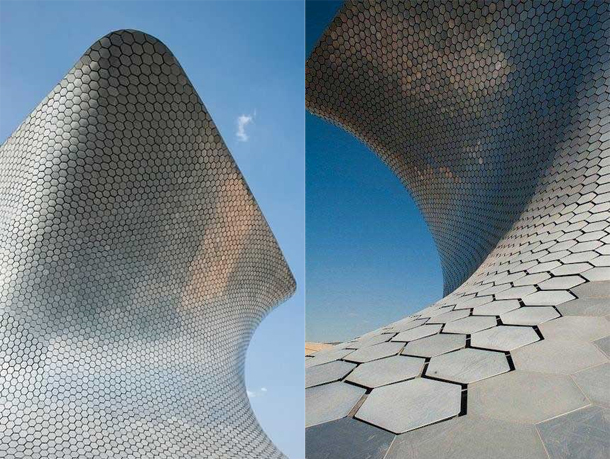
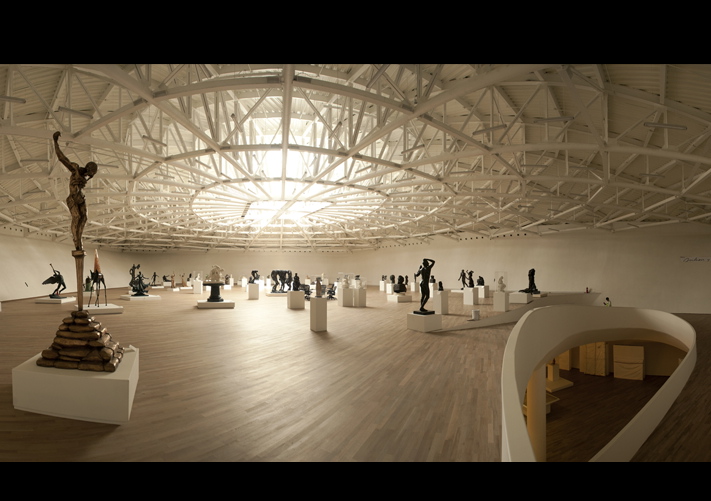
you think you've got a handle on the changes on your home planet, earth,
till you look into the world of modern architecture
these are images of Museo Sumaya in Mexico City

The first two images may be found at this link: http://dzunyck.com/tag/soumaya/
(No photographer credit is given for the first. The second is credited to Adam Wiseman.)
The bottom or third image is offered by Wikimedia Commons and is also attributed to Adam Wiseman. The link is as follows: http://en.wikipedia.org/wiki/File:08_MuseoSoumayaFREE_FernandoRomero_photo_by_Adam_Wiseman-1.jpg

I saw pictures of gardens in Singapore, that somehow reminded me of the cartoon show, The Jetsons (which, did you know, the original show only ran one season! 1962-3) Jane Jetson took me to Leonardo da Vinci, who took me to Michelangelo. Looking for images of Michelangelo's sculpture, La Pieta took me to the museum in Mexico City.
Subscribe to:
Posts (Atom)